
Charlesworth Author Services - Article on managing submissions from Chinese authors
In this article, Philippa Benson, of The Charlesworth Group, analyses some of the issues surrounding journal submissions from Chinese authors. She also offers tools and suggestions which may help journal editors and editorial offices better understand these submissions and therefore more effectively manage them.
Contexts and Tools for More Effectively Managing Submissions from Chinese Authors
By Philippa J Benson, Ph.D. Director of Strategic and Business Development, The Charlesworth Group (USA). Philippa lived in China for several years teaching scientific writing at a major university and studied Chinese in Shanghai as well as in the US. She works closely with The Charlesworth Group Publishing Services department, which carefully tailors language polishing resources and training programs to match the needs of authors and publishers in specialty areas.
Editors in many STM journals today are well aware of the deluge of papers starting to come in from researchers in mainland China. There are multitudes of problems with many of these submissions, some typical of authors writing in a second language, others particular to authors submitting from China, and others in line with the more usual problems that typify journal submissions.
These days, it’s reasonable to assume that Chinese authors who submit to STM publications are highly motivated to publish, perhaps more so than their counterparts from developing countries. Authors in China are under extraordinary pressure, with intense competition for scholarly success and recognition, if for no other reason than the sheer numbers of people in the academic job market there. In many fields, researchers cannot receive their final Ph.D. degree until they’ve published in a journal deemed by their institution to have enough status (e.g., a high impact factor). Some universities also award success in publishing with financial prizes, sometimes quite significant.
The pressure is not just from within the academic community, but comes down from even higher levels. In a 2009 article in the Harvard Business Review, John Kao noted some of the indicators of the intensity of China’s drive to excel in the international arena in science and technology including that the Chinese Politburo has set a national goal of turning China into an innovation-driven country by 2020. To support this goal, China has doubled the number of its institutions of higher education from 2,000 to 4,000 between 2002 and 2005. A study from the National Academy of Science also reported that China was awarding new Ph.D.s in the areas of science and technology at much greater rates than its nearest competitors in Asia.
|
|
Trends in Ph.D. awards in Asia in the fields of science and engineering, 1989-2003 Source: National Science Foundation: Asia's Rising Science &Technology Strength: Comparative Indicators for Asia, the EU, and the US
|
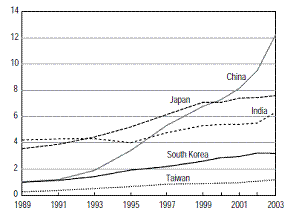
These are only a few of the indicators that show, one way or another, Chinese researchers will continue to submit articles for consideration in English language journals for some time to come.
The increasing number of submissions from China is in turn putting new pressures on STM editors, their offices and their reviewers. These editorial offices already have a tremendous amount of work processing submissions and separating the wheat from the chaff in identifying the best science that is the best match for the scope of each particular journal. With the very best journals accepting less than 5% of the articles they receive, editors need to sort through vast numbers of manuscripts to weed out articles that do not fall in the scope of the publication, do not adhere to the guidelines set out for authors, have weak scientific arguments or weak writing, or have any number of other problems. Once the potential candidates for review are chosen, many other steps must be taken to funnel articles to the appropriate associate editors and reviewers, to track reviews and their outcomes, to correspond with authors and eventually to get to publish final manuscripts.
Editors have to deal with yet another layer of complexity when they are faced with assessing manuscripts written in problematic English by authors who are largely unfamiliar with Western journal publishing practices. If the problems in papers submitted by nonnative speakers of English become too many in kind and number, editors may by default decide simply to put these manuscripts into the “reject without review” pile. While editors may not feel wholly “good” about making such decisions, given their workloads and priorities the reject pile may seem the most viable recourse. This unfortunate situation begs two questions: first what can an editor do to better and more fairly handle the onslaught of submissions from China and second what can be done to make these submissions better over time?
The challenge of experts writing in a foreign language
One step to understanding why papers come in from China the way they do is for editors to consider the background and context of the Chinese authors who are doing the writing. For example, it is highly likely that the vast majority of authors submitting articles to western STM journals learned both their spoken and written English from teachers who were not themselves native speakers of English. Although there are now many native English speakers in China, some of whom teach English, there are few English speakers in China who are trained to teach writing (composition) and even fewer who are trained to teach scientific writing. Textbooks and classes in writing for science and technology are very, very few and far between.
Written English is usually assessed primarily for correctness of grammar and syntax; issues of coherence, readability or style are much less often considered. In other words, in reviewing a text prior to submission, the nonnative English writer may not even detect weaknesses in logic or coherence (a problem that is not uncommon in native English writers either). Nonnative speakers of English writing in English about science for specific audiences in the specific formats required by STM journals have few textbooks available to them and few teachers or mentors to turn to for help with writing. In the end, the language in existing articles often ends up serving as the best models for successful scientific writing.
An editor might also consider that Chinese researchers, like their counterparts, come to the task of writing English from the base learning to write in their native languages. Written Chinese is a particularly difficult language to learn, in part because it is an ideographic language in which there is little correlation between the shape of the written word (orthography), the meaning of that word (semantics), and the sound of that word (acoustics). Learners must not only know that a particular character has a particular meaning and sound, but also must remember how to actually write that character according to somewhat complex patterns of strokes that must be written in a very specific predefined order. Although many cognitive skills are involved in learning to write in Chinese, developing basic literacy in Chinese requires learning to recognize and reproduce a minimum of 3000 characters through sheer, massive memorization, reinforced through repetition.
|
|
At left, one Chinese character showing the required order of strokes in writing. At right, a typical practice writing notebook for elementary students of written Chinese.
|

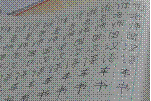
Certainly, pedagogy in China heavily emphasizes rote memorization for language learning as well as for other kinds of information. To aid in this memorization, exact copying is used as a primary pedagogical method, particularly as students are learning to write characters. Copying as a regular and usual form of learning continues through primary grades and is generally considered an acceptable method of learning. As students progress through primary school, they are regularly asked to imitate style in writing and speaking, continuing the general attitude of acceptance towards copying. Although, the value of originality comes to the fore as students enter higher education, the idea that “original work” has a high value is not planted in Chinese students until much later than in the US and elsewhere in the Western world during the process of formal education. If students start with an understanding that some form of copying is acceptable in an academic context, then understanding and avoiding plagiarism can be even more challenging.
All that being said, editors can have hope that instances of plagiarized text will lessen in submissions from Chinese authors. Authors in China and elsewhere have more and more information available on the web about what plagiarism is and how to avoid it by citing ideas and text properly. Chinese researchers are increasingly aware that journals use resources such as CrossCheck to scrutinize manuscripts and that these tools are very good at picking up plagiarized texts. They also know that editors will immediately reject papers in which plagiarism is found and that their records may well be given a black mark in future consideration. Chinese websites that help students and others understand and avoid plagiarism are now quite easy to find and the understanding that copying is not acceptable in certain contexts is becoming better understood. Organizations, like The Charlesworth Group, offer training and language editing services that not only help them polish their language but also check to make sure that non-original information, ideas and language are properly cited.

Chinglish
Complicating the task of evaluating whether or not ideas or text have been drawn from unacknowledged primary sources, editors dealing with papers by Chinese authors often also have to slog through “Chinglish” to assess the value of science being presented in papers written by them. Chinglish is generally defined as a mixture of Chinese and English that typically incorporates some Chinese vocabulary or constructions, or English terms specific to a Chinese context. Some problems with incorrect word choice or awkward grammar that are typical of Chinglish are not difficult to fix, while others are more difficult to edit because the base meaning is so unclear. Even senior editors are perplexed by a sentence like “The beaker ran across the lab.”
To provide authors who are not confident of their English writing skills with editorial help before submission, many journals are providing links on their websites to language polishing services. Some journals promote just one or two trusted services, while others provide authors with a long list of service providers with no particular endorsement. One way or another, most journals do make clear that having the English “polished” does not guarantee acceptance or guarantee that a paper will make it into peer review. Authors will certainly get some benefit from having their writing reviewed by professional editors who can point out where meaning is unclear or data poorly presented. However, these services come with a notable price tag, with costs ranging from $150 US for short articles to $300 or more for longer, more complex texts, and may be beyond reach for many authors, particularly those starting off in their careers.
Come again?
More than a few editors have also been perplexed by the persistence of Chinese authors in submitting what is essentially the same paper to the same journal time and time again. Again, bearing in mind the context in which Chinese authors are working may be helpful. As previously mentioned, many doctoral students in China, particularly those working in the sciences and engineering, will not be awarded their final degree unless they have published in an international journal that is considered to have a high impact factor in their field. In addition, Chinese authors are most familiar with the most famous journals, which are inevitably those with higher impact factors. At the same time young authors in China have real difficulty finding out about alternative venues for publication outside the famous high impact publications that everyone strives for. Few of these authors have advisors or other resources that might be able to give them a broader view of publishing opportunities, steering them to perhaps lesser known journals that might be more appropriate for the content they want to publish about.
As a result of knowing of only a few journals in their topical area and knowing that high impact journals are the best places to publish, many authors will take a manuscript that has been rejected, revise and polish to the best of their ability, and submit to the same journal again. Without more information about why a paper was rejected and about different places they might try to publish, authors will submit and resubmit to the same publication in the hope that a bit more spit-polishing of the text might do the trick to get their paper at least into review.
The role of explicit instructions for authors
Understanding more about the contexts and constraints of Chinese authors may be interesting, but it doesn’t really help solve the problem editors face in dealing with too many problematic papers from China. Unfortunately, there are no immediate solutions to coping with the flood of papers from the mainland, but there are steps that can be taken that will, over time, help Chinese authors and in turn the editors who deal with their manuscripts.
A first step is for an editorial office to set a period of time for keeping detailed records of articles coming in from China and why articles are rejected. This kind of data collection can be done quite simply, particularly if an office uses a manuscript tracking system. When the kind of problems that are typical in the manuscripts coming in from China are broken down by type, editors and editorial offices can develop specific and targeted responses to the problems by providing authors with information and resources to help avoid them.
Another step that can be taken lies in the critical resources of Instructions for Authors. Seasoned editors are well aware that authors from all kinds of backgrounds do not always follow the Instructions for Authors, and at times it may seem that some authors don’t even read the instructions. However, that does not diminish the influence that these guidelines can and should have on authors, particularly for nonnative speakers of English. Instructions for Authors can have greater influence and impact if they are written very clearly and specifically include instructional information about topics that are not easy for authors in nonwestern contexts to learn about. In addition, translating the instructions into Chinese and other languages will also be of great benefit to authors, making the process of understanding the rules of the game that much easier.
What kinds of information would be helpful to less experienced authors, particularly nonnative speakers of English? First might be a repeated clear and explicit statement of the scope and purpose of the journal. Editors regularly put submitted articles on the reject pile purely on the basis that the content falls outside the scope of the journal. Having clear and unequivocal statements of the scope of the journal in multiple places across a journal website, including in the Instructions for Authors, may help reduce these kinds of submissions.
Instructions for Authors can also much more explicitly lay out some basics of science writing and publishing. Editors might assume authors know what would be in a “Science Publishing 101” course, but the reality is that many do not. Information on some basics can be very helpful to young authors, moreso than editors may want to believe. For example, giving authors explicit definitions of plagiarism would be useful, followed by examples of how and why to cite sources. Telling authors to use active voice when possible can also be helpful as active prose tends to yield more clear and readable syntax. In countries where instructors of written English are not native speakers/writers and are perhaps of an older generation, many teachers still teach that passive voice is the preferred style for scientific writing.
Journal websites could also provide examples of poorly and well written abstracts, introductions and cover letters for authors and explain how these parts of an article and an author’s correspondence can play very significant roles in how an editor understands the gist of a submission on initial review. Examples and exemplars will draw potential authors to your site, which can never be a bad thing. Once a detailed analysis of some set of problematic papers is done, editors may be able to better understand what kinds of information they need to include more clearly in their Instructions for Authors.
The way that instructions are written can also be fleshed out to be more definitive and more helpful for authors. For example if your journal has strict word limits for articles, rather than just saying “Articles should be no longer than 2500 words,” the instructions could say “Articles longer than 2500 words will be immediately rejected without review. If you have trouble keeping your article under this required word count, you can consider hiring a professional editor to help you shorten your text.”
These are but a few tools that editors and editorial offices can use to help understand and manage the onslaught of papers from international authors, particularly those from China. Over time, Chinese authors will become more savvy about how and where to submit their science for publication and part of their education can (and perhaps should) come from journals themselves. In addition, a few specialized organizations such as The Charlesworth Group are uniquely positioned to help editors understand and better address the unique, powerful and growing audience of Chinese researchers. If editors beef up their instructions appropriately for authors, as they learn what authors need to hit the target of submitting the right paper to the right journal at the right time, many problems will be lessened. The journal can use the Instructions for Authors as the home base for information and send authors back to the directives, advice and models there through editorial, information in correspondence to authors and other communications.


